
A few weeks ago, during our Holy week liturgies, as well as our Easter Sunday Masses, we used incense and of course anytime we do so, I receive comments questions ranging from “What is the purpose?” to the offering of their opinion of the smell or whether they enjoy it or not.
My simple answer to people sometimes is that we use incense because as Catholics as well as Christians, God wants us to use all of our senses to understand Him more as well as to offer our worship to Him. The smells of BBQ, fresh baked bread, and fresh cut grass arouse our noses. They also fill us with warmth and welcome. Smells enhance our worship as well. The wax of candles, the bouquet of wine, and the perfume of chrism bring delight to Catholic people. But our most famous smell comes from incense. It signals the solemnity of our common prayer.
The occasions for incense range from the ordinary to the exalted. If we wanted, we could use incense every day of the year, but we generally reserve it for more important occasions.
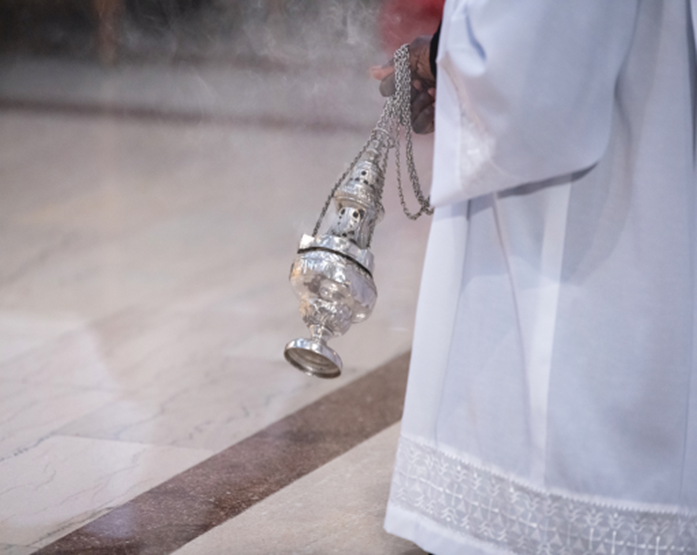
Several parts of the Mass call for the use of incense. When the entrance procession forms, incense may lead the way. When the Presider reaches the sanctuary, he may incense the altar in reverence. In the Gospel procession, the Deacon or priest may follow incense to the ambo, where he incenses the book before reading. After the gifts come to the altar, the celebrant may incense the bread, the wine, and the altar itself. Then a deacon or another minister may incense the priest and the people. When this happens, we stand up and bow when the minister bows before and after the incense. It's a stylized way of saying hello and receiving the incense, with the dignified humility of guests accepting a refill. During the Eucharistic prayer, when the priest shows us the Lord's body and blood, a minister kneeling near the altar, may incense this sacred banquet.
Other occasions invite incense, too. At a funeral, we incense the remains of the faithful departed. At Exposition of the Blessed Sacrament, we incense the monstrance. During solemn processions, incense takes the lead.
In the scriptures, incense symbolizes prayer. Psalm 142: 2 says, “Let my prayer be counted as incense before you.” Revelation 8: 3-4 says, “Angel with a golden sensor came and stood at the altar; He was given a great quantity of incense to offer with the prayers of all of the Saints on the golden altar that is before the throne. And the smoke of the incense, with the prayers of the Saints, rose before God from the hand of the Angel.” Incense delights the eye as well as the nose. As smoke rises mysteriously to the heavens, it bears our prayers up as well.
God Bless,